
You’re in 12th grade. Engineering feels inevitable. Your parents mention it. Your school talks about it. Your friends are applying.
But here’s the thing nobody really explains: What is engineering education actually for?
Is it for a degree? A job? Learning to code? Getting somewhere prestigious?
Most students have a vague idea. You work hard, you get into a college, you learn stuff, you get a job. That’s the story.
But that’s not actually what happens.
What Does a Perfect Engineering Classroom Actually Look Like?
Here’s something we’re obsessed with at Kalvium: What does the perfect engineering classroom actually teach?
Not perfect as in flawless. Perfect as in designed around what actually matters. Perfect as in structured so that what you learn connects to what’s real.
This question matters because your college choice will shape what you know and what you can do when you graduate. And most students don’t ask about it.
They ask: Is it a top college? What’s the placement rate? But they don’t ask: Will this place teach me things that actually matter right now?
That’s the question we’re trying to answer.
What Actually Makes a Classroom Perfect

A perfect classroom teaches what’s actually being built right now, not what was popular five years ago.
Think about it. Technology changes fast. The tools companies use today are different from what they used five years ago. The problems engineers solve today are different. The skills that matter have shifted.
A perfect classroom recognizes this. It doesn’t design a curriculum and keep it the same for five years. It watches what’s happening in the real world. It sees what engineers are actually building. It sees what companies are actually hiring for. And it teaches that.
A perfect classroom also teaches in a way that connects theory to real problems, not isolated concepts. You don’t learn database design in one semester and then never use it again. You learn it because your project needs it. You learn it because you’re building something and your database design matters.
A perfect classroom updates constantly because the world changes constantly. Not once every five years. Not even once a year. But every semester, it asks: What changed? What do we need to teach differently?
A perfect classroom prioritizes building over memorizing. Because you can memorize concepts and forget them. But when you build something real, when your code has to work, when your design has real consequences, you understand differently.
What Most Engineering Classrooms Teach Instead
Here’s what actually happens in most engineering colleges.
Someone designs a curriculum. It’s comprehensive. It covers important concepts. It gets approved by some academic board. Then it stays mostly the same for four or five years. Sometimes longer.
Why? Because changing it is complicated. It requires approvals. Faculty needs retraining. Textbooks need updating. Resources need changing. It’s bureaucratic and slow. So most colleges don’t do it. They keep teaching what they’ve always taught.
Meanwhile, the world is moving. New frameworks emerge. Old tools become obsolete. Companies shift what they’re looking for in new hires. But the college’s curriculum? It’s moving at its own pace, which is much slower.
So you learn concepts in isolation. Database design in one course. Algorithms in another. System design in another. They’re disconnected from each other. You learn them because there’s an exam, not because they’re connected to anything real.
And theory gets separated from practice. You spend Year 1 and Year 2 learning theory. Then maybe Year 3 you start doing projects. But by then, the theory has become abstract. You don’t remember why it matters. You don’t see how it connects to real problems.
This happens because most colleges think education is about transferring knowledge. You know concepts, you pass exams, you’re educated. But that’s not how learning actually works.
The Real Cost of Teaching Outdated or Isolated Concepts
Here’s what happens when you graduate from a college that teaches this way.
You graduate understanding concepts. You can explain what a database is. You can draw normalization diagrams. You passed your exams.
Then you join a company. Your manager gives you a real problem. Not a textbook problem. A real system with real constraints. Real users. Real performance requirements.
And suddenly, knowing what a database is doesn’t help. You need to actually design one. For 100,000 concurrent users. With performance constraints. With tradeoffs to make.
And you realize: I don’t know how to do this.
You know about databases. But you can’t actually design one. You understand the concept. But you can’t apply it to a real problem with real constraints.
This is the gap most engineering colleges never close.
Your first months at a job are spent learning what you should have learned in college. You’re behind peers who learned differently. You’re learning on the job instead of being ready to contribute immediately.
In a job market where companies expect you to contribute from day one, that gap is dangerous.
How a Perfect Classroom Would Actually Teach
A perfect classroom teaches in a fundamentally different way.
Curriculum reflects what engineers are actually building today. Not what sounds important. Not what’s in textbooks. What companies are actually using. What problems they’re actually solving.
Learning happens because projects need it, not because there’s an exam. You’re building an e-commerce platform. It needs a database. So you learn databases. Not in isolation. In context. Because your platform won’t work without good database design.
Theory comes in when you hit real problems, not before. Your code is slow. So you learn about data structures and optimization. Not because it’s on the curriculum. But because your project is slow and you need to fix it.
Updating happens constantly. Every semester, people ask: What changed in the world? What should we teach differently? If companies are moving toward something new, the curriculum reflects that. This semester, not next year.
This way, when you graduate, you don’t graduate with outdated skills. You graduate with skills companies are actually hiring for right now.
How Often Should a Perfect Classroom Update What It Teaches?
This is a real question with real consequences.
If a curriculum updates every five years, you learn what was relevant when it was designed. By the time you graduate, it’s already somewhat outdated.
If it updates every year, you’re better off. But the world moves faster than that.
If it updates every semester, you’re learning what’s relevant right now. Not what will be relevant. What is relevant.
How do you even decide what to update to? You watch what companies are actually doing. You see what technologies are emerging. You talk to engineers who are building in the real world. You see what skills companies are hiring for.
A perfect classroom has its finger on the pulse of what’s actually happening. And it adjusts constantly.
How You Actually Know If a Classroom Is Teaching What Matters
So how do you evaluate this? How do you know if a classroom is teaching what actually matters?
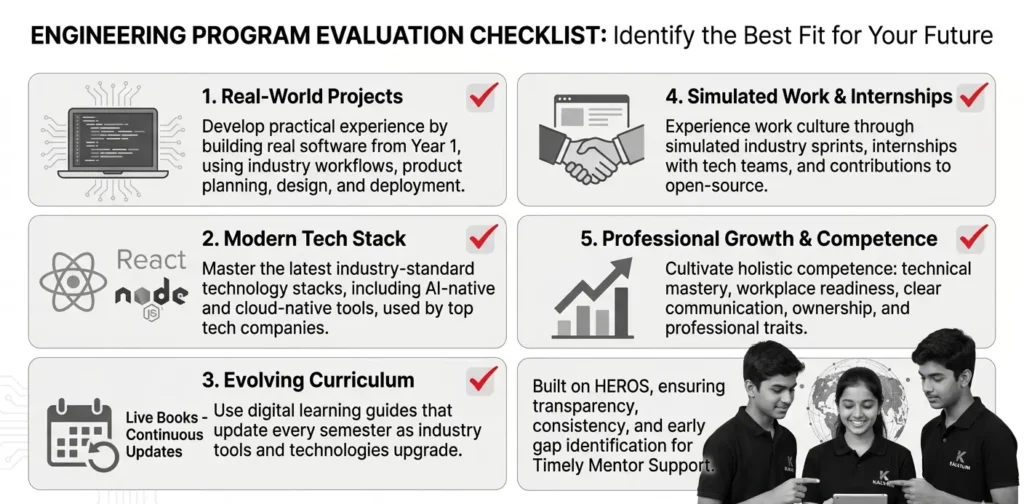
Ask current students. Real conversation. Not the polished interview answers.
Ask: What are you building right now? What does your project actually do? Is it a real e-commerce platform or a homework assignment?
Ask about technologies: What are you actually using? React? Node.js? Real databases? Or things you’ve never heard of companies using?
Check if companies are hiring for those skills. Look at job postings. See what technologies they actually need.
Look at their projects. See if they’re real or homework. Real projects have real constraints. Real projects have consequences. Homework projects don’t.
Ask: How does the curriculum change? Once every five years? Once a year? Every semester? That tells you how current the education actually is.
How a Perfect Classroom Would Actually Update
A perfect classroom doesn’t wait for approvals. It watches the world. It sees shifts happening. And it adjusts.
If companies are moving toward something new, the curriculum reflects that. Not next semester. This semester.
How? Because the people teaching aren’t just academics. They’re people connected to the real world. They see what’s changing. They understand why it matters. They can teach it because they understand it deeply.
This requires constant attention. Constant updates. Constant asking: What changed? What matters now that didn’t matter before?
It’s not easy. It’s not the traditional way. But it’s the way that produces graduates who are actually ready.
What We’re Learning at Kalvium About Teaching the Right Things
At Kalvium, we’re obsessed with this question. What should be taught? How do we stay current? How do we know when something needs to change?
Here’s what we’re learning:
You have to watch what’s happening in the real world. Not what was happening. What’s happening right now. What engineers are actually building. What companies are actually hiring for.
You have to ask: Why does this matter? How does this connect to real problems? Why should someone care about learning this?
You have to update constantly. Not because it’s trendy. But because the world is changing. And education that doesn’t change becomes irrelevant.
We don’t claim we have it all figured out. We’re learning. We’re iterating. We’re asking the question constantly: Are we teaching what actually matters?
And based on that answer, we adjust. Every semester, we ask: What changed? What should we teach differently?
That’s the beginning of answering the question: What does a perfect engineering classroom actually teach?
FAQ
1. How does Kalvium’s educational approach compare to other STEM-focused companies?
Most STEM-focused companies teach concepts and hope you can apply them later. Kalvium teaches by having you apply concepts immediately because your projects need them. Most companies have static curricula that update every few years. Kalvium updates every semester based on what’s actually being built. That’s the core difference.
2. What technical skills can I gain from Kalvium’s courses?
You’ll gain full-stack development skills (frontend, backend, databases, system design). You’ll learn React, Node.js, real databases, and system architecture. But more importantly, you’ll learn how to think about building systems, how to solve problems under real constraints, and how to learn new technologies quickly. The specific tools matter less than the thinking.
3. How does Kalvium’s approach to engineering education differ from traditional colleges?
Traditional colleges teach theory first, projects later. They separate subjects. They update curricula every few years. Kalvium builds from day one, integrates subjects around real projects, and updates every semester. Traditional colleges measure success by grades. Kalvium measures success by capability.
4. What programming languages and software tools are emphasized in Kalvium’s curriculum?
We emphasize React for frontend, Node.js for backend, real relational databases, and system design principles. Not because these are trendy, but because companies are actively using them and hiring for them right now. As the industry shifts, what we emphasize shifts with it.
5. How often does Kalvium update its curriculum to stay current?
Every semester. We watch what engineers are actually building. We see what companies are hiring for. We talk to mentors who are actively building in the industry. Based on what we’re learning, we update what we teach. We don’t wait for five-year cycles. We adjust constantly.