
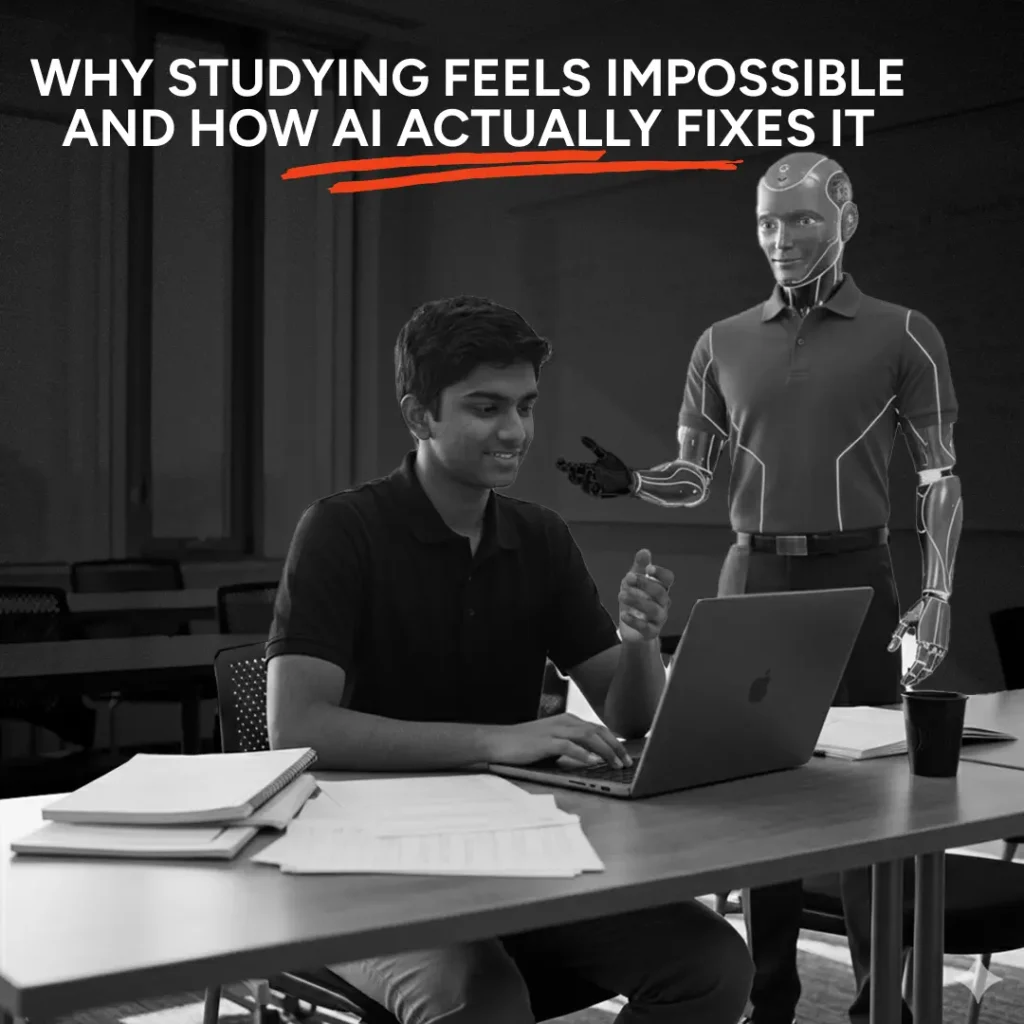
Here’s a paradox that defines learning today: we have more educational content and accessibility than ever before, yet sustained learning remains extraordinarily difficult. The bottleneck isn’t content. It isn’t accessible. It’s motivation, and more specifically, the feedback loops that fuel it.
Why Waiting Weeks, to Know If You’re Right, Kills your Motivation to Study
Traditional education operates on delayed gratification cycles that feel increasingly outdated. You learn a concept, complete an assignment, wait days or weeks for evaluation, and only then discover whether understanding occurred. By that time, the moment of learning has passed, the neural pathways have moved on, and the opportunity for immediate course correction is lost.
This lag isn’t just inconvenient, it’s demotivating at a fundamental level. Human beings are wired for immediate feedback. We need to know, in real-time, whether we’re progressing or floundering. Without this signal, motivation atrophies. The intent to learn, no matter how strong initially, cannot survive in a feedback vacuum.
In a world where AI can generate code in seconds, analyse complex data instantly, and provide answers to virtually any factual question, the old model of “learn, wait, test, discover” feels not just slow but irrelevant. Why memorise when information is instantly retrievable? Why practice without knowing if you’re practicing correctly?
Getting Feedback the Second You Need It
The transformation begins when feedback collapses into the learning moment itself. Think about it in this way: you write your code, submit it, and wait days to find out if your logic was even correct. By then, you’ve moved on mentally.
At Kalvium, we’ve been working to solve precisely this problem. Modern learning platforms are closing this gap through integrated evaluation systems that embed assessment directly into the learning flow. Imagine you’re working through a programming challenge and receiving not just automated code validation, but contextualised feedback on your approach: highlighting logical gaps, suggesting optimisations, pointing to conceptual misunderstandings before they calcify into persistent errors. This isn’t delayed judgment; it’s real-time guidance embedded directly into the practice environment.
The motivational impact is transformative. When formative assessments (quizzes, coding exercises, subjective responses) provide immediate insights, learners experience continuous progress rather than the anxiety of uncertain waiting. Each small win is recognised. Each stumble is met with specific guidance. You stay in flow rather than cycling through hope and disappointment on a weeks-long timeline.
How AI Explains the Same Thing a Hundred Different Ways
But immediate feedback alone isn’t enough. The second way AI revolutionizes learning is radical personalisation, not just of pace, but of pedagogical approach itself.
Consider how the same concept needs entirely different explanations depending on prior knowledge. A student with strong mathematical foundations learning quantum mechanics needs probability theory and linear algebra as entry points. Someone approaching from biology needs metaphors drawn from molecular interactions and energy states. A complete novice needs ground-zero intuition-building before any formalism.
Traditional education cannot provide this. One teacher cannot simultaneously deliver dozens of different explanations optimised for dozens of different cognitive starting points. But AI agents, trained on how thousands of people learn (their struggles, breakthroughs, effective analogies, and common misconceptions) can.
These agents become subject matter experts that adapt in real-time, drawing from vast training data about learning pathways. They recognise when a particular explanation isn’t landing and pivot to a different approach. They present examples calibrated precisely to your current comprehension level, challenging enough to extend understanding, but not so advanced that they overwhelm.
Recent developments in AI evaluation have made this particularly powerful. Systems can now analyse not just whether an answer is correct, but the reasoning behind it. When you submit a video response explaining a concept, or write a subjective analysis, AI can assess depth of understanding, identify misconceptions, and even suggest areas for the human instructor to focus on.
In practice, AI-powered evaluation can handle diverse response types (from code submissions to written explanations to video responses), providing both automated scoring and intelligent suggestions for human reviewers. This hybrid approach (AI providing instant preliminary feedback, humans adding nuanced guidance where needed) creates evaluation loops that are both fast and sophisticated. The instructor isn’t replaced; they’re empowered to focus on higher-order mentoring while the system handles immediate feedback and identifies exactly where human intervention will have the most impact.
When Your Textbook Actually Talks Back
The shift from textbooks to interactive digital content represents another crucial piece of the motivation puzzle. Static PDFs and lecture slides are knowledge repositories, but they’re passive. They don’t respond to confusion, don’t adapt to mastery, don’t provide practice opportunities embedded at the moment of learning.
Dynamic learning environments change this equation entirely. Imagine textbooks that aren’t just static pages but interactive environments where coding practice, conceptual quizzes, and rich media explanations exist side by side. When content itself becomes interactive (with embedded coding environments, immediate quiz feedback, multi-modal question types that test understanding in varied ways) the line between learning and doing blurs. You’re not just consuming information; you’re engaging with it, manipulating it, testing your understanding continuously.
This integration matters enormously for motivation. Practice isn’t separate from learning; it’s embedded within it. Feedback isn’t a separate event; it’s a continuous dialogue. You never have to wonder “Am I getting this?” because the answer is continuously available.
Seeing Exactly Where You Stand (And Where You Need to Go)
Here’s something subtle but powerful: In traditional classrooms, teachers guess at student understanding based on test scores and participation. They intervene reactively, after failure has already occurred.
Modern systems capture learning data at extraordinary granularity: session-by-session engagement, question-by-question performance, concept-by-concept mastery. This isn’t surveillance; it’s illumination. When an instructor can see exactly which students are struggling with which concepts, when they can track not just final exam scores but the learning journey itself, intervention becomes proactive and precise.
More importantly, you yourself can access this data. When you can see your own progress mapped across skills, identify specific gaps, understand exactly what you’ve mastered and what needs work, motivation shifts from external to internal. You’re not learning to please a teacher or pass a test; you’re learning because you can see yourself improving. The system becomes a mirror reflecting genuine capability development, not just grade accumulation.
Proving What You Know Right Now (Not Someday)
The traditional education model asks students to trust that knowledge will eventually prove valuable. Learn calculus now; you’ll use it someday. Memorise algorithms; employers will care. This deferred value proposition is motivationally weak, especially when the internet provides instant answers to most questions.
AI enables a different approach: immediate skill validation. Systems now let you demonstrate competency in real-time, earn recognised credentials for specific capabilities, and build portfolios of proven skills. When you complete a meaningful challenge (building a working application, solving a complex algorithmic problem, demonstrating fluency in a programming language) and receive immediate validation through proctored skill assessments, the motivation becomes self-evident.
Think of it like martial arts belt systems, but for technical skills. Practice intensively, demonstrate mastery in a controlled environment, earn recognition that’s externally meaningful. The skill isn’t theoretical; it’s demonstrated. The value isn’t deferred; it’s immediate. You can showcase these validated capabilities to potential employers, transforming abstract learning into concrete, portable credentials.
Understanding vs. Just Memorising for the Test
Perhaps most importantly, AI enables a fundamental shift from performance-based to mastery-based learning. In traditional systems, students learn to optimise for tests, memorising information long enough to reproduce it, then promptly forgetting. The motivation is extrinsic and temporary.
AI can instead focus on actual understanding. Through continuous dialogue and problem-solving, it can assess whether you’ve genuinely grasped a concept or merely memorised its surface features. It can keep probing until mastery is demonstrated, then ensure that mastery is maintained through spaced repetition and application in novel contexts.
When learners experience genuine understanding (when concepts click and they can apply them creatively) intrinsic motivation takes over. The reward becomes the learning itself, not the grade or credential. This is the holy grail of education, achievable at scale for the first time.
What This Actually Means for You
The opportunity you have now is unmatched. You can get something approximating a patient, knowledgeable, infinitely adaptive learning environment. One that responds immediately, personalises infinitely, and focuses relentlessly on true understanding rather than performative achievement.
The transformation isn’t hypothetical. Places implementing integrated, AI-enhanced learning platforms are already seeing the shift: from students who grudgingly complete assignments to learners who engage because they can feel themselves improving. From motivation maintained through grades and pressure to motivation sustained through visible progress and genuine capability development.
Students who receive immediate feedback on their code, who work through interactive content that adapts to their level, who can track their mastery granularly and demonstrate skills concretely. The difference isn’t marginal; it’s transformative. When learning systems close the feedback loop from weeks to seconds, when they provide personalisation at scale, when they make progress visible and skills tangible, motivation stops being the problem and starts being the solution.
The content is available. The access is there. Now, finally, we have the technology to sustain the motivation needed to bridge the gap between intent and achievement. The question isn’t whether AI can solve the motivation problem in learning. It demonstrably can, through immediate feedback, infinite personalisation, and focus on true mastery. The question is whether you’ll choose learning environments that use this, or stick with the old way of waiting weeks to find out if you understood anything.
This shift is happening now. The question is: are you ready to learn in a way that actually works?