
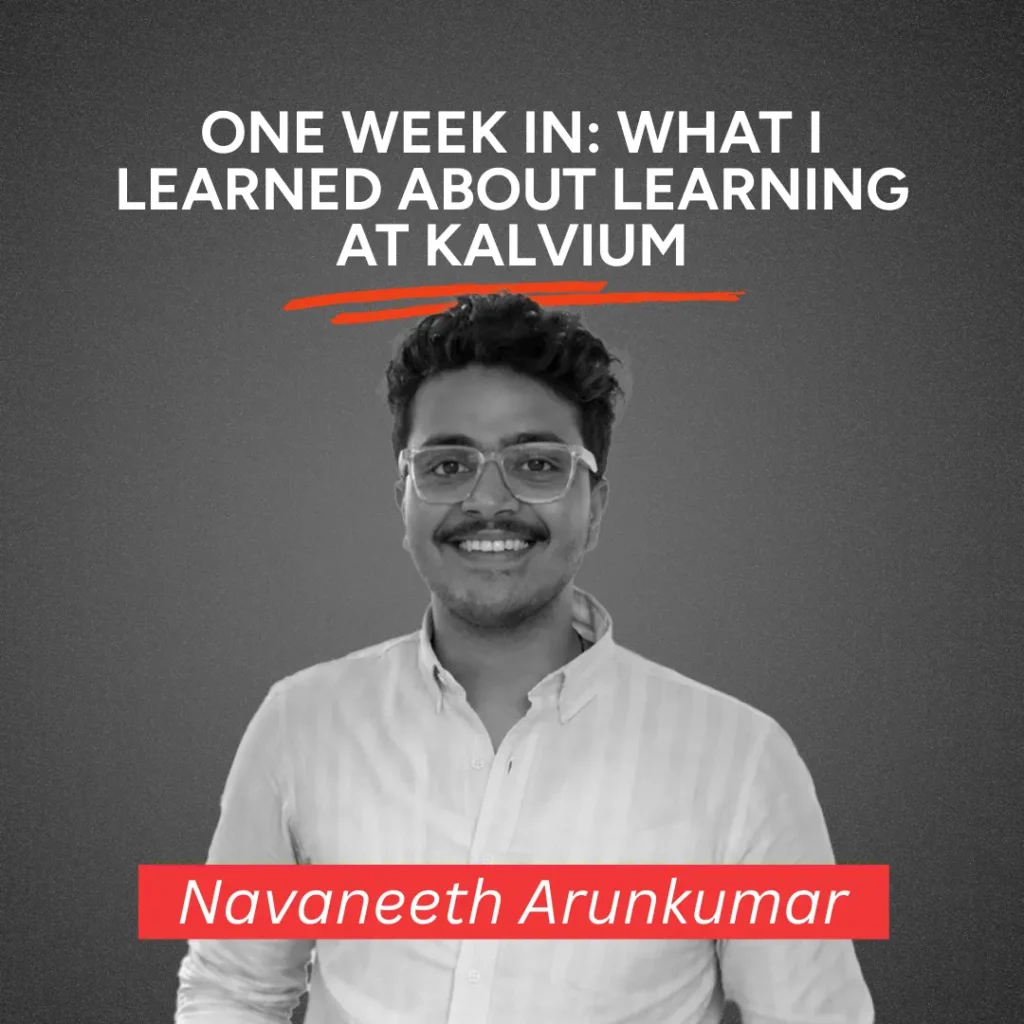
My name is Navaneeth, and this is what my first week at Kalvium actually taught me.
Not what I expected to learn. Not what the brochure promised. But what actually happened when I showed up, sat down, and started figuring things out.
If you’re trying to decide whether Kalvium is right for you, this won’t give you all the answers. But it might give you a clearer picture of what you’re actually signing up for.
Here’s what one week looked like.
What I Expected from My First Week at College
Before classes started, I had this mental picture of what college would be like. I imagined walking into a big lecture hall, sitting in the back, taking notes, zoning out occasionally, and then leaving when the bell rang. I thought I’d have a lot of free time. I thought I’d figure out the coursework as I went. I thought it would feel like an extension of 12th grade, just with more freedom.
Then I got the schedule. Nine AM to 6:30 PM. Monday to Saturday. My first thought was simple: “This is going to destroy me.”
Ten hours a day, six days a week. That’s not college. That’s a full time job. And I hadn’t even started yet. I looked around at my batchmates during the induction. We all had the same expression. Long faces. Quiet resignation. A shared sense of “what did we just sign up for?” I won’t lie. I was nervous. I was tired before we’d even begun.
But then the first day of classes actually happened.
The 10-Hour Day Reality Check
Here’s what I learned on day one: the schedule isn’t the problem. It’s how the time is used.
When I heard “10 hours of classes,” I imagined sitting in a chair, staring at a screen or a board, passively absorbing information until my brain shut down. That’s not what happened. The day was split into different kinds of learning. Live sessions where mentors walked through concepts. Self-paced time where you worked through material on your own. Breaks where you could step away, talk to people, process what you’d just learned.
It wasn’t ten straight hours of someone talking at you. It was structured in a way that actually made sense for how people learn. The live sessions were interactive. Mentors asked questions. They waited for answers. They walked around the room, checking in with students, seeing where people were stuck.
The self-paced time was productive. The study material, delivered through something called LiveBooks, was clear and well explained. You could move at your own speed. If you got stuck, you could ask for help. If you understood something quickly, you could move on without waiting for everyone else.
The breaks mattered. You had time to reset, talk to people, grab food, clear your head. The schedule wasn’t designed to exhaust you. It was designed to keep you engaged without burning you out. By the end of the first day, I wasn’t exhausted the way I thought I’d be. I was tired, yes. But it was the kind of tired that comes from actually doing something, not from sitting still and forcing yourself to pay attention.
That shift in how I thought about the schedule changed everything.
How Learning Actually Works Here
The biggest difference between Kalvium and everything I’d experienced before wasn’t the schedule. It was how learning actually happened.
In school, learning was passive. The teacher talked. You listened. You took notes. You memorized. You regurgitated it on a test. Then you forgot it. At Kalvium, you can’t learn that way even if you wanted to. You have to actually do the work.
The material is delivered through assignments that require you to apply what you’ve learned. You can’t just read the explanation and move on. You have to code something, build something, solve something. If you don’t understand a concept, you can’t fake it. The assignment will expose that gap immediately.
At first, that was frustrating. I wanted shortcuts. I wanted someone to just tell me the answer so I could move on. But the mentors don’t work that way. They guide, they don’t spoon-feed.
When I got stuck, I’d ask for help. And instead of giving me the answer, they’d ask me questions. “What have you tried so far?” “What do you think is causing the issue?” “How would you approach this differently?” At first, I thought they were being difficult. But slowly, I realized what they were doing. They were teaching me how to think through problems, not just solve this one specific problem.
That’s harder. It takes longer. But it sticks.
Peer learning matters more than I expected. One thing that surprised me was how much I learned from other students. If someone in the class understood a concept better than others, they were encouraged to explain it. Not in a “show off” way, but in a “let’s help each other” way. And here’s the thing: explaining something to someone else forces you to actually understand it. You can’t just repeat what the mentor said. You have to break it down, simplify it, make it make sense.
I learned as much from explaining things to others as I did from asking for help myself.
The Culture Shift: Calling Mentors by Their First Names
This one felt weird at first. In school, you always called teachers “sir” or “ma’am.” It was automatic. It was respectful. It’s what you were supposed to do. But at Kalvium, you call everyone by their first name. Mentors, peers, everyone.
The first time I did it, I stumbled. It felt disrespectful. Like I was crossing a line. But the mentors explained why. In the real world, you don’t call your manager “sir” in a meeting. You don’t email your teammate as “ma’am.” You work together as equals, even if you’re at different levels of experience.
Respect doesn’t come from titles. It comes from how you show up and what you contribute. By the end of the week, I’d adjusted. And honestly? It changed how I interacted with people. I stopped waiting for permission to ask questions. I stopped feeling like I needed to be perfect before speaking up.
I just participated.
Building Trust When You Don’t Know Anyone
When I first arrived at LPU, I didn’t know anyone. I was surrounded by strangers. We were all starting from the same place, but that didn’t make it less intimidating. And I had questions running through my head. “Can I trust these people?” “Will they judge me if I ask a dumb question?” “What if I’m the only one who doesn’t get it?”
One week later, those questions feel less urgent. Not because I suddenly became best friends with everyone, but because the environment makes it easier to trust.
The induction activities helped. During the first few days, we did games and group activities. Some of them felt cheesy at first. But they worked. You can’t stay guarded when you’re laughing at yourself, when you’re working together to solve a challenge, when you’re sharing something vulnerable with the group. Those moments broke the ice faster than I expected.
The collaborative learning structure built trust naturally. When you’re helping someone debug their code, or they’re walking you through a concept you didn’t understand, you start to rely on each other. You realize that everyone is struggling with something. Everyone has gaps. Everyone needs help sometimes. That shared experience creates connection.
Psychological safety isn’t just a buzzword here. One thing the mentors emphasized from day one was that this was a space where you could make mistakes, ask questions, and try things without being judged. And they didn’t just say it. They actually created that environment. When someone gave a wrong answer in class, the mentor didn’t dismiss it. They explored why that answer made sense, what the logic was, and where the thinking went off track.
That made it safe to participate. Safe to be wrong. Safe to learn. By the end of the week, I wasn’t best friends with everyone in my batch. But I knew I was in a space where I could show up, struggle, and grow without feeling like I had to hide my confusion or pretend to know more than I did.
That mattered more than I realized at the time.
What Keeps You Going When It Gets Hard
Let me be honest: the first week was hard. Not impossible. Not unbearable. But hard. There were moments when I didn’t understand something and felt stuck. Moments when I submitted an assignment and got feedback pointing out everything I’d missed. Moments when I was tired and just wanted a break.
So what kept me going? The mentors actually cared. This sounds simple, but it’s rare. The mentors at Kalvium don’t just show up, deliver a lecture, and leave. They stay. They check in. They give feedback on every assignment. They answer questions late into the evening. When you see someone putting in that much effort to help you learn, it makes you want to put in the effort too.
The work felt real. I wasn’t just completing assignments to get a grade. I was building things that actually worked. Solving problems that felt real. That made the struggle feel worth it.
The community pushed you forward. When everyone around you is working hard, showing up, trying to figure things out, it’s easier to do the same. There’s a quiet accountability that comes from being part of a group where everyone is committed to learning. You don’t want to be the one who gives up or stops trying.
I could see progress. By the end of the first week, I could look back and see how much I’d learned. Not just in terms of content, but in terms of how I approached problems, how I thought through challenges, how I communicated with others. That progress, small as it was, gave me confidence that I could keep going.
What One Week Actually Taught Me
Looking back, here’s what I learned in my first week at Kalvium.
Learning is active, not passive. You can’t just show up and absorb information. You have to engage with it, struggle with it, apply it. That’s harder, but it’s also what makes it stick.
The schedule isn’t the enemy. Ten hours a day sounded terrifying. But when the time is structured well, when it’s designed around how people actually learn, it’s manageable. The key is that it’s not ten hours of sitting still and listening. It’s ten hours of doing, thinking, and growing.
You don’t have to know everything. I came in thinking I needed to have all the answers, that I couldn’t afford to look confused or ask basic questions. But the environment at Kalvium rewards curiosity, not perfection. The students who learn the most are the ones who ask the most questions.
Community makes the hard parts easier. You’re not doing this alone. You’re surrounded by people who are figuring it out with you. That makes the struggle feel less isolating and more like a shared journey.
One week is just the beginning. I’ve barely scratched the surface. There’s so much more to learn, so many more challenges ahead. But after one week, I feel like I understand what I’m working toward. And I feel ready to keep going.
Still Wondering About Your First Week? Here’s What Students Ask
1. Is Kalvium suitable for beginners in technology and engineering?
Absolutely. Most students come in with minimal or no coding experience. What Kalvium looks for is your willingness to learn and push through challenges. The first week is designed to get everyone on the same page, regardless of background. I came in with basic knowledge and was nervous about keeping up. By the end, I realized my starting point didn’t matter as much as my commitment to learning.
2. How does Kalvium’s hands-on learning experience compare to traditional universities?
It’s fundamentally different. Traditional colleges often spend the first two years teaching theory, then maybe a project in the final year. Kalvium flips this. You’re coding, building, and solving real problems from day one. The 10-hour schedule isn’t ten hours of passive lectures. It’s live sessions, self-paced learning with clear material, and strategic breaks. It’s designed for actual learning, not just surviving.
3. Are there opportunities to collaborate on projects with peers during Kalvium courses?
Yes, constantly. Collaboration is built into the structure. You work with your cohort, help each other understand concepts, and solve problems together. There’s no “showing off” mentality. Everyone is trying to learn. Explaining concepts to others forces you to understand them deeply. You learn as much from teaching peers as from asking for help.
4. Can I get personalized mentoring through Kalvium?
Yes. Mentors guide you, but they don’t spoon-feed answers. When you’re stuck, they ask you questions that help you think through the problem yourself. This approach is harder at first, but it teaches you how to solve problems independently. Mentors are available throughout the day and even answer questions into the evening. They genuinely care about your learning.
5. What career benefits can I expect from completing Kalvium’s programs?
You develop real skills that matter in the industry. You learn to build things that work, solve actual problems, and think independently. You work with mentors who have real industry experience. You build a portfolio of projects that showcase what you can do, not just degrees on a resume. By the end of the first week, I felt like I was becoming someone who could contribute meaningfully to a team.
6. Is the 10-hour schedule really as intense as it sounds?
It’s long, but it’s not overwhelming. The time is structured with live sessions, self-paced learning, and breaks. By the end of the day, you’re tired, but it’s the productive kind of tired.
7. What if I don’t understand something during self-paced learning?
You can ask for help from a mentor or a classmate. The environment encourages asking questions, so you’re never stuck for long.
8. Do you really have to call mentors by their first names?
Yes. It feels strange at first, but you get used to it. It changes the dynamic from “teacher and student” to “people learning together,” making it easier to participate.
9. What if I’m not good at working in groups or asking for help?
You don’t have to be good at it on day one. The program structure naturally pushes you to collaborate. You’ll get better just by doing it.
10. Is the first week harder than the rest of the program?
The first week is more about adjustment than difficulty. You’re getting used to a new way of learning, a new environment, new people. The content itself isn’t overwhelming.
If you’ve made it this far, you already know more about what Kalvium actually is than most people who just read the brochure. You know it’s not easy. It’s rigorous. Intentionally rigorous. Ten hours a day, six days a week, isn’t a schedule you coast through. It’s a schedule designed to push you, challenge you, and fundamentally change how you think about learning and problem-solving.
Kalvium isn’t for everyone. It’s for people who genuinely want to learn, who are willing to struggle, who understand that real skill-building requires real effort. If you’re looking for an easy path, this isn’t it. But if you’re looking for a path that actually prepares you for the real world, where you build things that work and solve problems that matter, then the rigor starts to make sense.
Navaneeth’s first week at Kalvium taught him something he didn’t expect: that the hardest parts of learning are often the parts that matter most. The struggle, the confusion, the moments when you don’t understand and have to figure it out, those are what actually build capability. Kalvium leans into that. The mentors know it. The structure knows it. The community knows it.
The intensive structure feels brutal at first. But by the end of the first week, you start to understand why it exists. Every hour is designed to develop real competence, not just pass time. That’s the difference between a college and Kalvium.
If you’re reading this and thinking about applying, or if you’re already accepted and wondering what you’re getting into, I hope this gave you a clearer picture of what you’re signing up for.
If you have any questions about the program, reach out to the team.
You can contact Kalvium at +91 9483 200 300 or visit our website.